
“While we in the West continue to study Clausewitz, our adversaries are reading Sun Tzu”
On 28 October, Fundación ESYS hosted its inaugural annual meeting in Madrid, titled Security in Times of Uncertainty. Graham Cundy OBE, Head of Capability at Earendel Associates, joined the panel Anticipating Hybrid Threats: Public-Private Cooperation in the Age of Cyber Intelligence. Ahead of the event, El Confidencial interviewed Graham about emerging hybrid threats and the importance of corporate resilience in an increasingly contested geopolitical environment.
The interview was originally published in Spanish and has been translated into English using artificial intelligence for accessibility and convenience. The original Spanish article remains the authoritative version and can be found here.
In the era of peaceful globalisation, companies sought advice from diplomats and trade experts. In a sign of the times, the private sector is increasingly turning to people with military backgrounds and geopolitical risk analysts. Colonel (Ret.) Graham Cundy speaks with the authority of someone who knows war both from the field and from the planning table. A former Royal Marine and recipient of an honour in the Order of the British Empire, he took part in counter-insurgency operations as a member of special forces deployed in Afghanistan and Iraq, and worked in some of the world’s most complex theatres during his 25-year military career.
Since entering the reserve, Cundy, born in 1967, has applied his experience across different theatres of operations and his strategic knowledge in several roles serving the UK public administration. Now, at the consultancy Earendel Associates, he advises companies, governments and academics on navigating a new global context marked by risk, hostility and conflict. He spoke to us for just over half an hour before appearing at the Security in Times of Uncertainty forum organised by Fundación ESYS, where he joined the panel Anticipating Hybrid Threats.
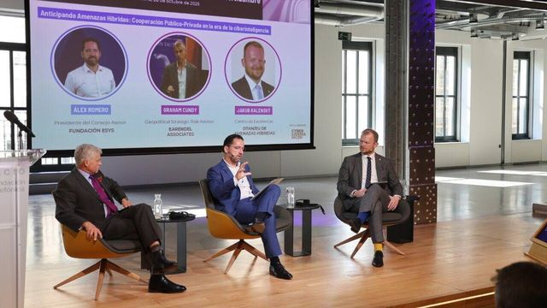
Cundy during his appearance at the ESYS Forum at Fundación Telefónica, Madrid. (Fundación ESYS)
QUESTION. Hybrid warfare is now part of the familiar strategic and information landscape: large-scale cyberattacks, sabotage of critical infrastructure, drones closing airports and disinformation campaigns. How prepared are European armed forces, governments and societies to deal with this new situation?
ANSWER. Calling this hybrid warfare can be misleading. I prefer hybrid conflict or grey-zone conflict. When we use the word “war”, we automatically think that it is a problem for the military or NATO to solve. But what we need to consider is how a society reacts and responds to activities below the threshold of war, including through the intelligence agencies, legal system, media and police. It is not a new phenomenon; it has existed for a long time.
Q. But today it is occurring with unprecedented intensity, and a great deal is at stake.
A. It is becoming more prevalent because it is incredibly cheap and allows the attacker to deny responsibility. What we are seeing at present is deliberately designed and calibrated not to cross the threshold of war. We see highly intelligent adversaries, not only in Russia but in many places, such as the Chinese around Taiwan, constantly seeking to increase pressure, probe our capabilities and observe our reactions. You can buy a drone for a few hundred euros, create chaos and conceal who is responsible. This presents liberal democracies with a dilemma: if we do nothing, we demonstrate weakness and encourage the aggressor; if we respond, we risk escalation.
Q. How, then, should we operate in this grey zone?
A. In the West, from a military perspective, we think in terms of NATO and Article 5. Our thinking is very binary, and the Western view as a whole is very linear: peace or war; Article 5 or no Article 5. Grey-zone confrontation, however, seeks to identify and exploit weaknesses in order to attack us in those intermediate scenarios. Many of our adversaries do not study Clausewitz; they appear to read Sun Tzu, whose thinking is far more appropriate, particularly the idea that the most decisive battle is the one won without fighting at all. Hybrid hostility seeks to erode our cohesion, our society and our way of thinking, in order to win the war before the first battle.
Q. I understand Clausewitz to represent the rational, structured Western view: war as the continuation of politics by other means, with armies, strategies and clear objectives. Sun Tzu represents a more flexible, psychological and subtle approach: winning without fighting, and using deception, patience and adaptation. What lesson should we draw from this?
A. The cognitive domain is a key aspect, namely the will of the people. This is where AI really comes into play, through bots and bot farms. We can see it in the disinformation now being spread, and in the capacity to flood the information space and increase the level of noise surrounding genuine reporting. The dissemination of false stories seeks to erode our Western democracies and fracture our societies through the use of AI, fabricated messages and the proliferation of hateful content from bot farms.
This is deliberately designed to create divisions within Europe and its institutions, while also creating space for voices within our own societies that promote nationalism or populism, leading to further fragmentation. When people think about conflict, they tend to see it as a problem for the state. I would argue that it is increasingly a problem for the commercial and private sectors because they are the weakest links.
Q. This increase in hybrid attacks is taking place against the backdrop of the war in Ukraine. The European military consensus is that our security and defence framework for the remainder of this century depends on the outcome of that conflict. Can Kyiv still win?
A. That is the million-dollar question. Nobody thought the Ukrainians would still be fighting four years after the attack, yet they are. Yes, they are slowly ceding ground, but this year’s Russian offensive has failed to achieve its objectives. That is why we are seeing an increase in hybrid activity within Europe, as a second front through which Russia can punish those who most strongly support Ukraine. It is no coincidence that we are seeing more hybrid activity in the Baltic states, Denmark and Germany, as well as incursions in Poland and Estonia. This sends a very strong message to Ukraine’s closest allies. Russia may not be doing well militarily, but Putin can still achieve results by other means.
Q. Many analysts also believed that Russia would implode, but there are no signs of an imminent collapse.
A. One should never underestimate Russia’s capacity to absorb significant casualties. I think it is losing economically, not on the battlefield. Russian losses are already enormous, but its resources are considerable. Ukraine’s ability to fight asymmetrically against Russian power, as demonstrated by attacks on the Black Sea Fleet and its capacity to undermine hydrocarbon exports and now key fuels within Russia itself, is having an effect. The question is how long, and to what extent, Russia can continue absorbing this. I believe Russia is vulnerable. If we were united in our sanctions, that would make a significant contribution.
Q. As a geopolitical risk consultant, which emerging conflicts or flashpoints should companies be considering?
A. China and Taiwan are fairly well covered. However, there is a difference between that situation and Russia–Ukraine. China is in a much stronger economic position, and I believe time is on its side. In my view, therefore, we are not facing an imminent war crisis there. I think we will see a gradual escalation and an increase in pressure, but with China believing that it will ultimately prevail over Taiwan. This creates a degree of near-term stability that we do not see elsewhere.
Q. Which other areas concern you?
A. One area of significant concern is destabilisation in Africa, particularly in the Sahel. This represents a fundamental shift. We are seeing a range of actors, including Russian paramilitaries and some Chinese entities, destabilising areas where we may not previously have had the greatest influence, but did possess some, and that influence is now declining.
We will also see great-power competition over rare earths. The Democratic Republic of the Congo is an area that deserves greater attention, particularly the competition for control, not only political but also commercial. There is, of course, also the fighting on its borders involving the M23 movement and the Congolese army.
Q. In 2011, you wrote a column warning that military operations in Afghanistan were failing to “win the hearts and minds” of the local population. A decade later, in 2021, Kabul fell without resistance. The world now appears to understand only hard power. Is soft power dead?
A. Soft power is certainly not dead. The point is that it is difficult to exercise soft-power influence without credible hard power that safeguards your freedom to promote it. We need to deter the hard power of our potential adversaries and the threat it poses to our societies. Although we are not currently at war, we are engaged in a daily contest in this grey zone, and our hard power protects that. Why must we compete in the grey zone? I would argue that we are fighting for our soft-power narrative, for our vision of the world.
Q. The war on NATO’s eastern flank has demonstrated that the United States provides the Alliance’s hard power. Could Europe exercise that deterrence if the transatlantic relationship were called into question or fractured under Donald Trump’s presidency?
A. The alliance with the Americans is significant. Their technological and intelligence dominance makes a difference. But do not underestimate NATO. Acts of aggression, such as MiG-31 incursions into Estonia or drones over Schleswig-Holstein in Germany and over Poland, are significant. NATO’s response was significant too. Although one might question the asymmetry of shooting down a $5,000 drone with a $350,000 missile, NATO has the capacity to respond today, and Europe’s borders are fully defended. I believe the increase in hybrid or grey-zone activity is a consequence of these demonstrations of strength by the Alliance. I do not believe Russia could confront NATO and win, even without support from our American allies. The European allies are more than capable of defending themselves against Russia.
Q. Public bodies and companies, not only those in defence, are increasingly seeking advice and management expertise from former senior military officers. What can people from the armed forces bring to private companies and civilian government?
A. There are two interesting points. There is an expression: “In peace, you innovate; in war, you adapt.” The military mindset brings an ability to say: “We have a problem today. What do I have that I can use to solve it now? Not tomorrow, and not by buying new cyber software. No. What can I do to make it work today?” That is the first point: practical people who make the best of a bad situation today.
The second is resilience and a resilient mindset. In the military, we must always think ahead. The best time to plan crisis management is not during the crisis, but beforehand. Even though it may be tedious and costly, we need redundancy. We need plans so that we know exactly what we are going to do and how we are going to do it. We also need robust communications to keep our people together, from a company perspective, our employees, as well as those who buy or supply our products. We must send the message that we know what we are doing.
Q. We are witnessing an accelerated robotisation of warfare, with increasingly autonomous vehicles and weapons systems equipped with artificial intelligence. How concerned should we be?
A. We should always be concerned about the growth of technology that makes war easier or more devastating. We should be concerned, but we should also have confidence in ourselves. We must not underestimate the ability of our own societies and humanity to counter some of these threats. Although the current picture may appear dystopian, we should not forget that the Ukrainians were able to defend themselves against a significantly superior military power that also had the advantage of surprise. The will to win often overcomes technological advantage.